What universities don't tell FYP
Desgining a Foundation Year Pharmacist program
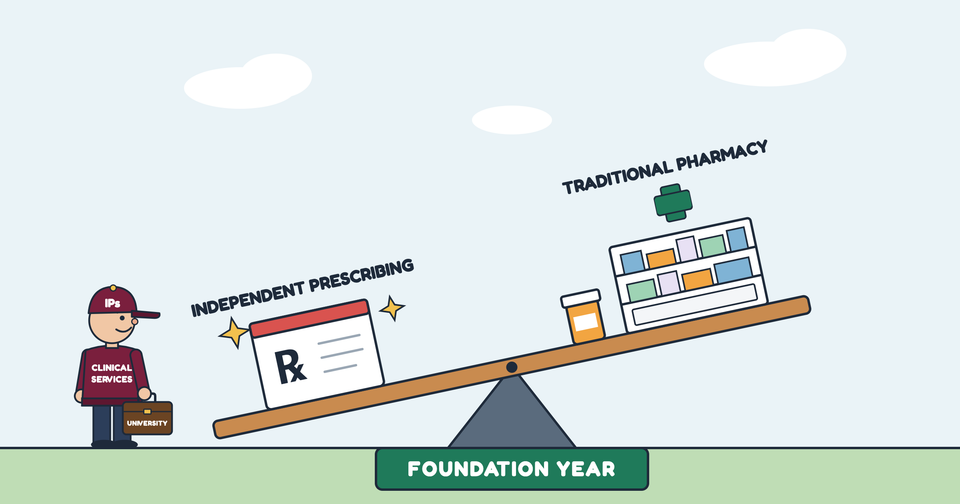
Creating and planning the foundation year pharmacist (formely pre-registrtion pharmacists) training year is tricky, especially now, as they qualify as independent prescribers off the bat.
They come out from university, fresh off the back of their newly minted MPharm, primed, expecting to be doing high-flying clinical activities because they're not regular pharmacists. They're going to be independent prescribing pharmacists. That means, in practise during the training year, all they want to focus on is prescribing, clinical examinations and skills, consultations, and anything that's more clinically focused.
But the reality of the situation is that I know plenty of GP and hospital pharmacists that do little to no prescribing. For example, my friend in a GP practise in a surgery in Manchester cites that he never prescribes anything and uses his IP qualification. He just answers queries and does clinics, which often don't need prescribing at all. Same for my friends still in hospital, except those who run clinics. Otherwise, they do little or no prescribing. The trainees are baffled by this, as they've been trained and geared for a world of solely prescribing.
And this is where we run into problems in community pharmacies because trainees in the community often feel like they are above dispensary management and operations. But it's the foundation of being a pharmacist, and you can't do the rest without it. That can even be said. That can even be true in a hospital pharmacy. The irony of it all is that I've seen community pharmacy trainees leave, complete their pre-registration (their foundation year), go straight into GP practises, and then just spend their days handling drug tab queries, out-of-stock supply issues, guideline changes, and stuff: the exact stuff that they would have mastered if they paid attention enough in community.
I do believe that it's genuinely good that community pharmacy in England is becoming more clinical, but I also believe that none of it works unless you can effectively run a dispensary, keep the stock in, make legal supplies, and stay compliant. Without the basics, there's no room for anything on top.
We're two years into running this foundation year pharmacy programme. In our first year, we took the trainee pharmacists' word that the uni has prepared them to see and deal with patients. They had explained how they've received vaccination training, clinical exam training, and done multiple OSCEs. They assured us that their training was different to earth and they are ready to meet patients.
However, when the rubber met the road? They arrived very green, and putting them in front of patients straight away is just beyond risky. How we got around this was that we created a consultation competency framework where they work through this pathway:
- They start out observing the pharmacists conduct consultations, usually a number around 20. They write up a description of the consultation and then reflect on it. Usually, it's about 20 or so per station. However, we do increase that as needed if we just feel that they're not getting it. On their notes, we also reflect on their description and reflexion of it and give them feedback.
- They progress to a supervised phase where they begin with a minimum of 20 consultations supervised by the pharmacist, doing the same notes, description, and reflexion. We give feedback based on their notes.
- They progress onto a trainee-led consultation framework where they conduct the consultations mostly by themselves, but they come in, come out, share the notes with the pharmacist, and we agree on a decision together. Then they go back into the patients.
This framework has taken months to get through, and we were hoping it would be quick. When we actually got into it with them, we just didn't feel safe putting them with patients. However, we found this framework protects patients and helps build their skills in a more sustainable manner.
However, this created a big dilemma.
We felt we had to start them with consultation training essentially straight away so that we have the time to train them sufficiently to keep the patient safe. But then, by doing that, we reinforced the exact imbalance we're trying to correct. We reviewed our options, such as holding off patient-facing work until the second half of their year and focusing on dispensary first, or getting them safe and ready to do consultations first and bringing them back into dispensary. Either way, we reinforce this imbalance.
We don't have all the answers, and in fact, sometimes we even think maybe we're approaching this all wrong.
We have noticed this from students who come from every university. We don't think it's any university in particular that gears them up for a clinical life in community pharmacy without putting any emphasis on the day-to-day operations.
I personally believe that universities' incentives are that they get people in the door and fill up these courses, so they sell a big prescribing promise: you're basically the new doctors, new course, new programme, new powers. However, that's simply not what it's like in practise.
For people who say, "Oh, dispensing robots will remove the need to do pharmacy operations," even if that's the case and we all spend $100,000 to $200,000 on fancy vending machines, there will still need to be a pharmacist's name on the door because someone has to be accountable. When something goes wrong, they're not going to be able to do it manually because they won't know how. And also, robots don't solve drug tariff issues or supply issues. They only just solve the dispensing aspect.
We've really enjoyed building this foundation year programme and keep refining it, and we want to get the balance right. But I think focusing on the clinical and prescribing aspects at the expense of pharmacy operations and everything included in that is real short-term thinking. I still think that when everyone says there's alpha in lagging, now that everyone's focusing on consultations and prescribing, there's real alpha in being a class dispensary pharmacist.